US President Donald Trump has declared what he is calling the most sweeping economic offensive ever launched against any nation, threatening Iran and any country that continues to support it with devastating financial consequences, as his administration's 2026 Iran war approaches the six-month mark with no resolution in sight.
In a post on his Truth Social platform, Trump announced the escalation in characteristically emphatic terms, writing that Tehran had been given every opportunity to reach a deal and had failed to take it.
"Therefore, today, I am announcing the MOST CRUSHING ECONOMIC OPERATION EVER TAKEN AGAINST ANY COUNTRY!" Trump wrote. "This will be Economic Warfare and Isolation on an unprecedented scale."
What Trump's Economic Warfare Threat Means
Trump's announcement goes beyond Iran itself. Any country whose financial institutions, businesses, airports or government entities provide "any type of lifeline to Iran" will face what he described as "TREMENDOUS Economic Consequences." While the president did not name specific nations, the warning carries obvious implications for China, which purchases more than 80 per cent of Iran's exported oil according to 2025 analytics data.
Trump specified that his prohibitions would target oil smuggling, cash transfers, exchange houses, ship registries and front companies — the financial plumbing that has allowed Iran to continue trading despite decades of existing sanctions. "It all needs to stop NOW. You know who you are," Trump wrote, urging US allies to stand with Washington in isolating Tehran.
Treasury Secretary Scott Bessent indicated the measures would be unlike anything seen before, with formal announcements expected imminently. Data from the US Treasury Department's Office of Foreign Assets Control shows the agency has already sanctioned more than 1,000 people, vessels and aircraft since Trump began his second term — including targeting Iran's shadow oil fleet, shipping insurers, weapons-acquisition networks and digital exchanges, with an estimated US$500 billion (A$697 billion) in Iran-linked cryptocurrency frozen.
Sanctions experts say one significant lever still available to Washington involves Chinese independent refineries — known as "teapots" — which account for roughly a quarter of Chinese refinery capacity and absorb much of the Iran oil trade. While larger Chinese financial institutions have so far been spared formal designation, the Treasury has warned at least two major Chinese banks that they could face secondary sanctions if Iranian funds are found moving through their systems. Hitting those banks could have a chilling effect on bigger institutions, experts say, though it risks triggering retaliation from Beijing.
Iran Fires Back — and So Does Oman
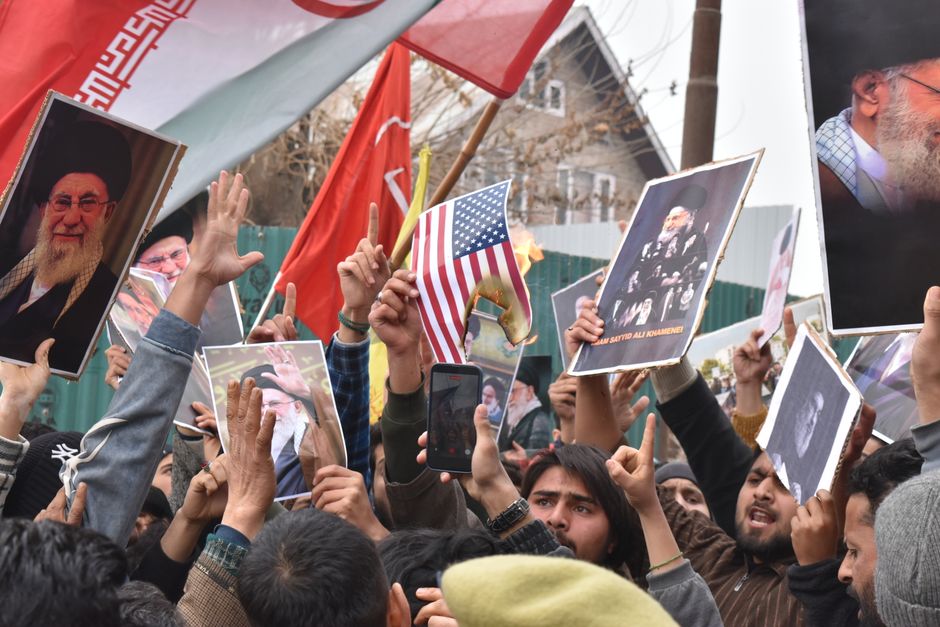
Iran, which has endured punishing sanctions since the late 1970s, was defiant in response. Mohsen Rezai, the head of Iran's supreme national security council, delivered a blunt warning on Iranian television: "We declare to all countries ... do not join the economic war waged by the United States. Any country participating in the imposition of economic restrictions against us is considered an enemy."
China has also criticised the US push, arguing that sanctions will not resolve the Middle East conflict. Tehran's position is reinforced by the fact that oil shipments through the Strait of Hormuz are already at a virtual standstill, with Iran threatening to strike any unauthorised oil tankers attempting to transit the vital waterway.
The economic warfare announcement follows a separate and explosive diplomatic flashpoint involving Oman. Days before the sanctions declaration, Trump threatened to bomb the Gulf state if it interfered with US efforts to take control of the Strait of Hormuz. "If Oman gets in the way, we'll bomb the s*** out of them," Trump said in a phone interview. He repeated the threat later the same day when speaking with reporters in the Oval Office, adding: "I don't think they behaved very well, but we'd handle them very easily."
Oman — a US ally that borders the United Arab Emirates, Yemen and Saudi Arabia and sits near the strait — had been engaged in talks with Iran over shipping arrangements through the waterway, a stance that clearly angered Washington.
A Conflict Escalating on Multiple Fronts
The economic warfare threat marks a significant escalation as the US-Iran conflict, which began in February when US and Israeli forces launched strikes on Iran, grinds toward its sixth month. US military strikes on Iran have continued relentlessly, with the conflict triggering an Iranian blockade of the Strait of Hormuz and attacks on Gulf state infrastructure that have sparked a global energy crisis.
The new economic offensive comes immediately after the expiry of a 60-day memorandum of understanding agreed to in June, under which the two countries had committed to negotiate an end to hostilities and reach an agreement on Iran's nuclear programme. That window has now closed without a breakthrough, prompting Trump's announcement of maximum economic pressure.
Washington has been pushing allies to join its campaign to isolate the Iranian economy, though the coalition of willing partners remains uncertain — particularly given the economic interdependencies that tie major economies to Iranian oil. Trump's implicit warning to China, combined with the threat against Oman, signals that the administration is prepared to confront even nominally friendly nations if they are seen as propping up Tehran.
Treasury Secretary Bessent's anticipated press conference is expected to provide more detail on the specific mechanisms of the new sanctions regime, which officials have promised will represent measures that have "never been seen" in the history of US economic statecraft.