Serbia's long-dominant ruling party has been defeated at snap parliamentary elections, with veteran leader Aleksandar Vučić conceding on Monday (AEST) that preliminary results show a student-backed protest movement has surged ahead. The vote marks the end of more than 14 years of unbroken political control by Vučić's Serbian Progressive Party (SNS), and was decided on the back of the highest parliamentary election turnout Serbia has recorded in over three decades.
Vučić concedes as celebrations erupt in Belgrade
"Based on a stratified sample, it is clear that we lost these elections," Vučić told supporters gathered at his party's headquarters in Belgrade on Monday AEST. His concession came within hours of polls closing, and almost immediately triggered celebrations across the Serbian capital. Cars honked their horns in the city centre, crowds gathered near the election commission's headquarters, and at the Student List's own headquarters, supporters applauded, wept and embraced, chanting "Victory, victory!"
"I feel incredible. I feel as though I am finally living in a free country," one student at the List headquarters told reporters. Outside a Belgrade polling station earlier in the day, another voter captured the mood plainly: "It cannot continue as it was during the past 14 years."
Record turnout driven by nearly two years of protest
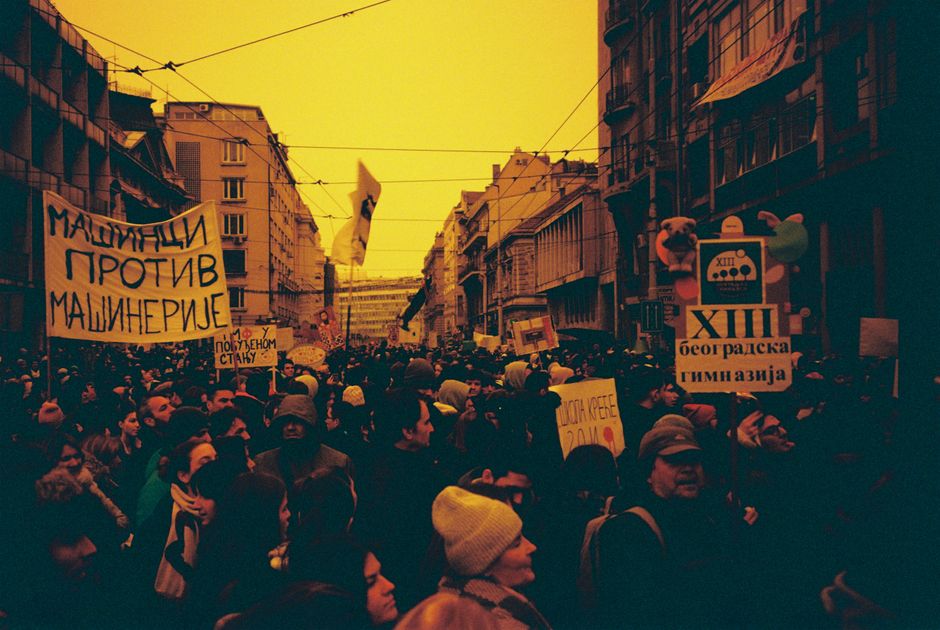
The snap election is the culmination of almost two years of student-led demonstrations that began after a canopy collapsed at Novi Sad railway station in 2024, killing 16 people. The disaster was widely blamed on corruption, and triggered some of the largest protests Serbia has seen since the fall of strongman Slobodan Milošević in 2000.
Voter participation reached extraordinary levels on Sunday. By 6pm local time, two hours before polls closed, nearly 65 per cent of Serbia's 6.4 million registered voters had already cast their ballots, surpassing the previous benchmark set at the 1993 parliamentary election, when just over 61 per cent voted. Long queues formed outside polling stations before doors opened and persisted throughout the day in Belgrade and across the country.
Serbs living abroad also turned out in striking numbers. Videos circulated online showing diaspora voters dancing in the streets of Los Angeles and gathering in a Toronto bar for early-morning celebrations, with polling hours in Canada following the Serbian time zone. Long lines of cars formed at borders with Croatia, Hungary and Kosovo as Serbs abroad returned home to vote.
The Student List and the fight for parliament
Eighteen electoral lists contested seats in Serbia's 250-member parliament, but the race was largely understood to be a contest between the SNS and the student-backed Student List. The Student List is a selection of candidates supported by a movement that has been deliberately and largely leaderless throughout its two years of activism.
Several established opposition parties chose not to field their own candidates, instead directing their supporters to back the students, a decision that is widely seen as having consolidated the anti-government vote. Experts had predicted beforehand that an unusually high turnout would favour the student movement over Vučić's right-wing populist party.
Irregularities and security concerns noted
The election was not without controversy. The head of election observation for civil society group CRTA noted that "a large number of irregularities continue to be recorded, while violent incidents outside polling stations are also becoming increasingly frequent." Isolated incidents were confirmed, though police did not report any major election-related violence.
A significant riot police presence was visible in Belgrade's city centre, with officers seen surrounding the election commission building, the presidency, and a nearby protest encampment. The heavy security deployment reflected the high-stakes atmosphere surrounding an election that, in the end, delivered a historic political shift for Serbia.