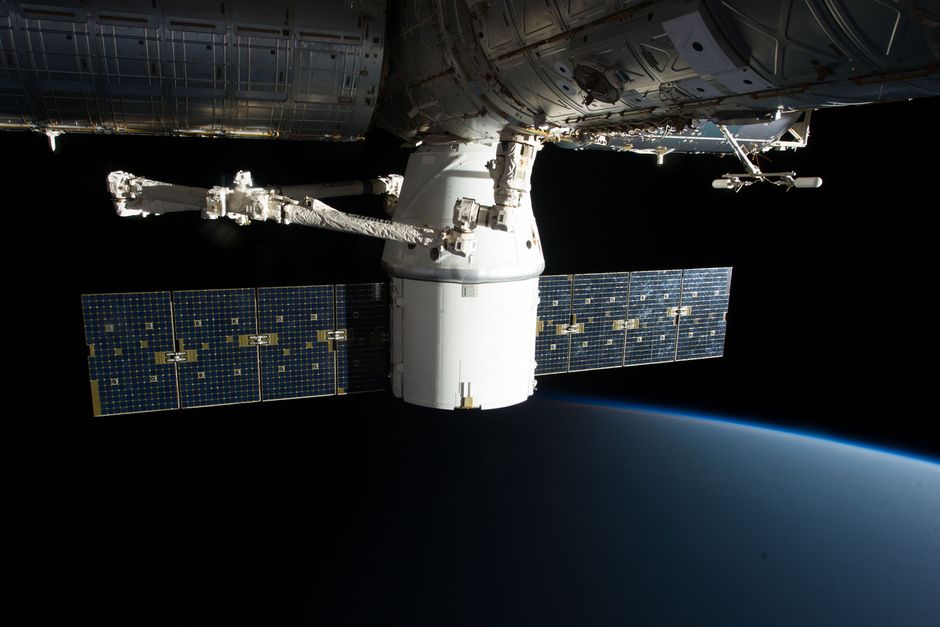
The United States military has publicly confirmed for the first time that it operates weapons in Earth's orbit, a landmark admission that signals a new and openly acknowledged phase in the global militarisation of space. Senior defence officials made the disclosure at a major annual aerospace conference, describing on-orbit capabilities designed to defend American forces against hostile action from adversaries — most pointedly China and Russia.
US Air Force Secretary Troy Meink made the first public acknowledgement on Monday, telling attendees at the Air, Space and Cyber Conference that the United States "has on-orbit space control weapons capable of defending the Joint Force against hostile adversary action." The following day, US Space Force chief Douglas Schiess went further, stating his branch was actively operating "on-orbit weapons that can defend the Joint Force against space-enabled attacks" and pledging "disciplined and responsible choices" as the orbital defence arsenal expands in the years ahead.
Neither official would elaborate on the types of weapons involved when pressed by reporters, and it remains unknown precisely when the weapons were placed into orbit. The admissions nonetheless represent what analysts describe as a significant shift in Washington's willingness to speak openly about aggressive postures in space. You can read more on this confirmation in our earlier coverage of how the US government confirms it has deployed space weapons in Earth's orbit.
What Space Weapons Actually Look Like
While specific details remain classified, space weaponry is broadly understood to fall into two categories. Kinetic weapons involve warheads or projectiles capable of striking or detonating near a target — typically another satellite — to destroy or disable it. Non-kinetic weapons take a more subtle approach, using jammers, directed-energy lasers, and cyberattacks to render enemy space systems inoperable without physically destroying them.
Beyond these categories, analysts note that so-called dual-use technologies are increasingly blurring the line between civilian and military applications. Robotic arms designed for satellite servicing could theoretically be repurposed to grapple and disable an adversary's spacecraft. In 2022, China demonstrated precisely this kind of capability — commanding a satellite to grab onto another spacecraft and reposition it in orbit, a manoeuvre that could, in a conflict scenario, be used to capture or disable a rival's assets.
Rendezvous and proximity operations — known as RPOs — have also drawn concern. These involve satellites manoeuvring close to other spacecraft in low-Earth orbit, and Western satellites have reportedly been "buzzed" by foreign counterparts. Analysts warn that in a conflict, any satellite capable of such manoeuvres could rapidly be converted into a crude hunter-killer, severing critical communication links and shifting the strategic balance.
The Growing Threat From China and Russia
American defence officials have repeatedly pointed to China and Russia as the primary drivers behind the US push to arm its orbital assets. The US Space Force's own public communications describe China as developing "space and counterspace capabilities as part of a military modernisation strategy," while characterising Russia as a nation that "views space as a warfighting domain and believes space supremacy will be a decisive factor in future conflicts."
Reports indicate Russia has been conducting satellite constellation training missions that Washington believes could be rehearsals for "attack and defend tactics" in future orbital combat. More alarming are intelligence assessments suggesting Russia has pursued development of a space-based nuclear weapon — one designed to generate a massive electromagnetic pulse capable of disabling vast numbers of commercial and government satellites simultaneously. Moscow has denied those claims, but the potential consequences are severe: disruption to weather forecasting, global navigation systems, cargo shipping, banking infrastructure, and emergency services could all follow from such an attack.
China, meanwhile, has been linked to the development of a nuclear-capable partial-orbit hypersonic missile, adding another layer of complexity to an already fraught strategic environment.
Legal Grey Zones and the Arms Race in Orbit
The 1967 Outer Space Treaty prohibits the placement of nuclear weapons or other weapons of mass destruction in orbit, but it contains no blanket ban on conventional weapons in space or ground-based weapons targeting space assets. That legal ambiguity has left significant room for interpretation — and exploitation — by major powers.
The US is already flying its own secretive military spaceplane, the X-37B, which bears a resemblance to a miniature Space Shuttle. Built by Boeing and measuring eight metres in length, the vehicle — formally known as the Orbital Test Vehicle — operates on classified missions with undisclosed capabilities. One mission saw it spend more than two years continuously in orbit before returning to Earth in 2022.
The US recently completed its largest orbital exercise to date, called Apollo Manoeuvres, involving satellites across multiple orbits and participation from international and commercial partners. The exercise was designed to demonstrate dynamic space operations and test coordinated responses to emerging threats.
President Donald Trump, who established the Space Force in 2019, has consistently championed American dominance in the domain. A December executive order declared US space superiority "a measure of national vision and willpower" and tied orbital defence development to his proposed Golden Dome missile defence system — an ambitious, multibillion-dollar initiative modelled in part on Israel's Iron Dome, intended to intercept threats including any future placement of nuclear weapons in space.
"It is critically important that we maintain our dominance not only in the air but in space," Meink said at the conference. "We've had to take steps to make sure that when we're threatened, we can take care of that."
Whether those steps will stabilise or further inflame an increasingly contested orbital environment remains one of the defining strategic questions of the coming decade.