A new exhibition at Town Hall Gallery in the Hawthorn Arts Centre, Victoria, is asking visitors to do something increasingly rare: put their phones down and pay attention. Slow Read brings together nine multimedia and collage artists from across Australia in a show that transforms books and printed matter into tactile, multi-dimensional works demanding genuine engagement in an age of endless digital distraction.
What the Slow Read Exhibition Is About
The exhibition is built around a simple but pointed premise — that meaningful art requires time, and that time is exactly what most of us no longer give it. Curator Rachel Keir-Smith says the works on show can offer deeply rewarding experiences, but only for those willing to linger.
"The artworks can offer a rich and meaningful encounter when viewers are open to them, but this requires time," Keir-Smith says.
Among the contributing artists are Gracia and Louise, a Naarm/Melbourne-based duo who have been collaborating since 1999 on collages, prints, zines and drawings that frequently explore the natural world. Also featured is Nadia Hernández, a Venezuelan-born artist whose work Palomita/Soledad — roughly translated as Little Dove/Solitude — incorporates verse fragments taken from a poem written by her grandfather.
Weaving Time: Artist Jacky Cheng's Painstaking Process
One of the exhibition's most labour-intensive works comes from Jacky Cheng, a Malaysian-born artist of Chinese heritage who lives and works on Yawuru Country in Broome, Western Australia. Her contribution, titled Thrums, plays on the dual meanings of the word: a thrum can refer to a steady, repeated wave of sound, or historically to the leftover thread from a loom.
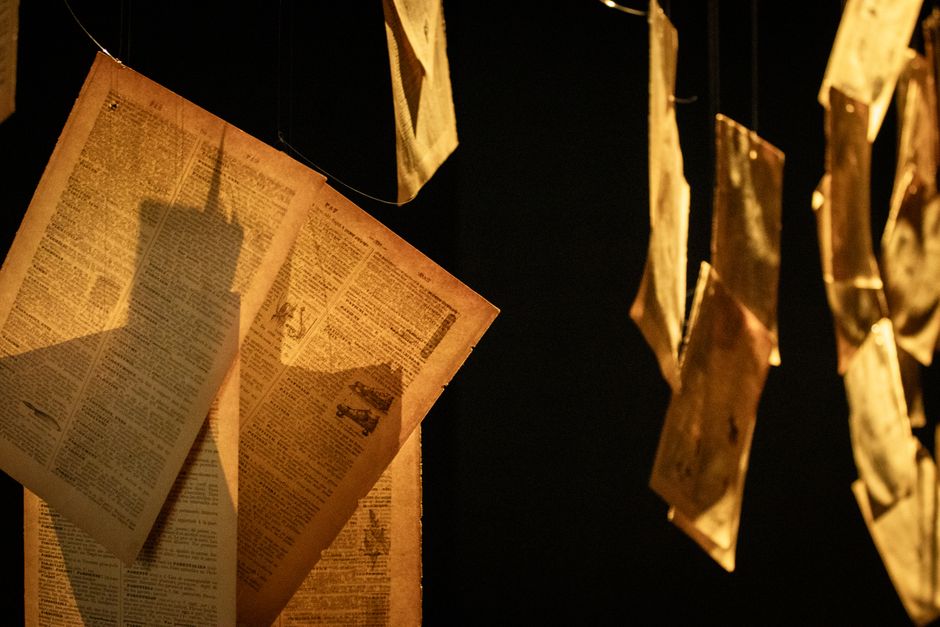
Cheng wove together kozo paper offcuts and old calendars — some of which had belonged to her grandmother — before stitching the pieces together with nylon. The stitching alone took close to a year to complete.
"I often think of weaving as a way of bringing fragments together," Cheng says. "Individual pieces of paper might hold one story, but when they're woven together, they create a relationship with one another."
She describes the process as a direct counterpoint to the compulsive, rapid-fire nature of scrolling through social media. "The act of weaving, it's the opposite [of doom-scrolling]. It's repetitive, deliberate and definitely time-intensive. The work really asks the audience to spend time with it rather than immediately understand it. The meaning unfolds gradually."
Cheng — who also works as a visual arts teacher — acknowledges she is not immune to online distraction herself. Her solution, however, is decidedly low-tech: she made herself a cardboard phone to place on her desk. "I place it on the table, and I'll look at it and say 'See, I've got no messages!'" she says with a laugh. She also found that handling emails first thing in the morning and then committing to four or five uninterrupted hours of art-making significantly boosted her productivity.
First Nations and Emerging Voices
The exhibition also features Jayda Wilson, an emerging First Nations artist of Gugada, Wirangu, and Thai descent who lives in Karna Yauta (South Australia). Wilson's work, titled (un)silenced, is among the contributions that bring diverse cultural perspectives to the show's central themes of identity, memory and the printed word.
Why It Matters Now
In a media environment where digital platforms increasingly dominate daily attention, Slow Read positions itself as a quiet act of resistance. The assembled works don't simply celebrate books and print — they argue, through their very making, that slowness and deliberation are values worth reclaiming. For visitors willing to accept the challenge, the exhibition promises an encounter that no screen can replicate.
Slow Read is showing at Town Hall Gallery, Hawthorn Arts Centre, Victoria.