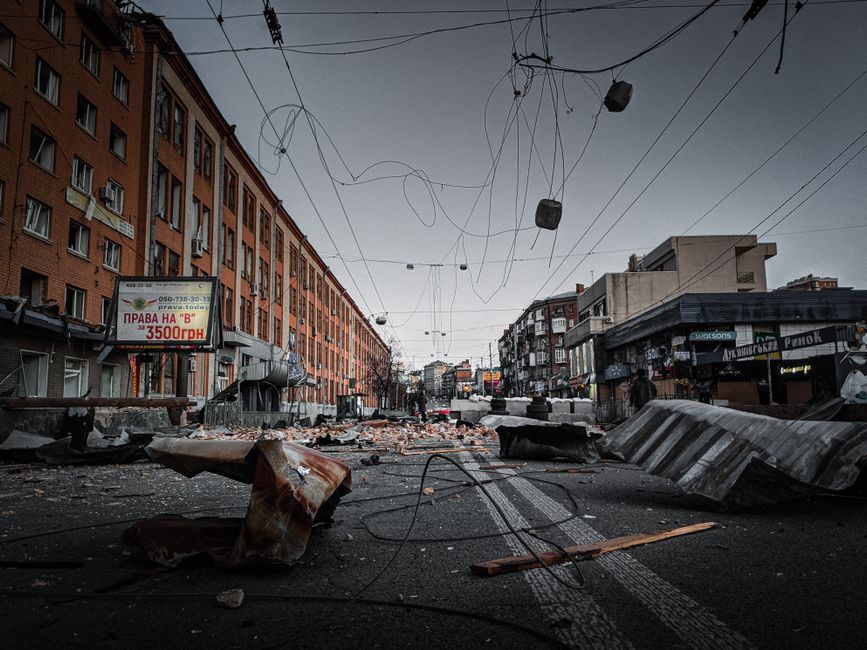
Russian missile and drone strikes across Ukraine killed at least 25 civilians, including five children, and wounded around 100 others overnight, in one of the deadliest attacks in recent months — an assault that Ukrainian President Volodymyr Zelenskyy said was timed to coincide with Russian President Vladimir Putin's 74th birthday.
Zelenskyy had warned the day before that Ukrainian intelligence had concluded Russia was massing for a "massive" strike, yet despite that foreknowledge, Ukrainian air defences were unable to prevent significant casualties and damage across more than a dozen regions, including the capital, Kyiv.
Apartment Block Destroyed in Pryluky, Killing 19
The deadliest single incident occurred in Pryluky, in the northern Chernihiv region, where a Russian missile obliterated a five-storey residential building. At least 19 people were killed there, including five children, with around 50 more wounded. Emergency crews used excavators, shovels and ladders to comb through the collapsed sections of the building, searching for survivors in the rubble.
Zelenskyy described the Pryluky strike as among the most "vile" attacks Russia had carried out, accusing Moscow of deliberately targeting civilian infrastructure. "Today, as a birthday 'gift' to Putin, the Russian army destroyed a residential building in Pryluky," he said.
In his evening address, Zelenskyy was blunt about the intent behind the assault. "This is the 'gift' that Putin gave himself for his birthday: the killing of children, the killing of people," he said. "The Russians wanted to strike painfully and demonstratively."
Deaths were also confirmed in the cities of Kyiv, Oleksandria and Kremenchuk. In Kremenchuk, in the Poltava region, two people were killed and seven more injured, according to regional authorities, with rescue operations still continuing at the time of reporting.
Air Defences Strained as Russia Deploys New Drone Technology
Ukraine's air force said it intercepted just over 80 per cent of the 46 jet-powered drones launched by Russia during the attack — a notably higher interception rate than recent weeks, when air defences had been neutralising between 50 and 60 per cent of incoming drones on average. No explanation was immediately provided for the improved performance.
Since mid-year, Russia has sharply escalated its use of high-velocity, jet-propelled drones capable of striking targets around the clock. Their speed has exposed critical gaps in Ukraine's existing air defence network, which was already under severe strain from relentless aerial bombardment.
Ballistic missiles remain the most serious threat Ukraine cannot adequately counter. The US-made Patriot air defence system is the only weapon in Ukraine's arsenal capable of intercepting such high-velocity projectiles, but global supplies are critically tight. Zelenskyy said his team was "every day looking for Patriot systems that can and must protect people's lives," noting that shortages have been worsened by competing demand driven by the conflict involving Iran.
Without sufficient Patriot interceptor missiles, Ukraine is left largely unable to stop Russian ballistic strikes. The country is simultaneously working to develop a new generation of interceptors capable of catching the newer jet-powered drones, though that effort is still in progress.
Many Kyiv residents sheltered in the city's deep underground metro stations as air raid warnings spread ahead of the incoming strikes.
Russia Claims It Targeted Military-Industrial Sites
Russia's defence ministry described the overnight operation as a "massive strike" conducted using high-precision land, sea and air-launched weapons, as well as drones. It claimed the targets were military-industrial facilities involved in the production and storage of missiles and drones in Kyiv and multiple other Ukrainian regions, including Chernihiv, Kirovohrad, Dnipropetrovsk, Poltava and Kharkiv.
The ministry also said port and ship repair facilities in the southern Odesa region were struck, along with vessels carrying cargo for the Ukrainian military.
Ukraine, meanwhile, reported hitting four targets inside Russia over the same 24-hour period, including two oil facilities.
Broader Context: A War of Attrition With No End in Sight
The strikes are the latest chapter in a grinding aerial campaign that has intensified as ground forces on both sides remain largely deadlocked — more than four and a half years after the 2022 Russian invasion of Ukraine began. Western analysts say Putin is pressing ahead under the belief that sustained bombardment will break Ukrainian resolve, and that Kyiv's Western backers will eventually lose their appetite for the conflict.
European Commission President Ursula von der Leyen condemned the attacks, saying: "Russia is pursuing a deliberate strategy of terror — trying to make daily life impossible for Ukrainians who want to live in peace."
Ukraine received a fresh €1.2 billion tranche from the European Union on Wednesday, which Prime Minister Sergii Koretskyi said would be directed towards defence needs.
US-led diplomatic efforts aimed at ending the conflict appear unlikely to produce any near-term breakthrough, with even low-level technical talks still under discussion rather than scheduled. As negotiations stall, the aerial war continues — and for Ukraine, the toll is mounting in ways that risk becoming unsustainable.
"That is exactly what the enemy is counting on," Zelenskyy said. "For us to be afraid to fall asleep. To let our children out of our sight. To plan anything. So that everyone thinks: next time it could be my address."