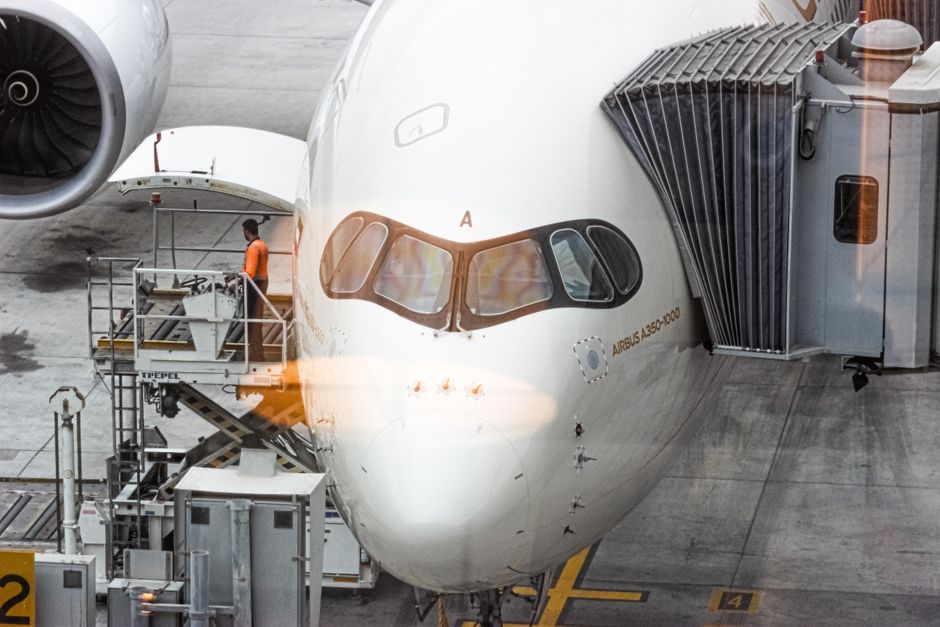
A specially modified Qantas aircraft has touched down in France after spending more than 24 hours continuously in the air, setting a new world record for the longest commercial flight ever attempted and bringing the airline's ambitious Project Sunrise one step closer to reality. The Airbus A350-1000ULR departed Melbourne and landed in France after 24 hours and 24 minutes in the air, covering a staggering 23,057 kilometres without a single stop.
A record that rewrites aviation history
The previous distance record for a commercial aircraft had stood for two decades. A Boeing 777-200LR had flown 21,601.7 kilometres from Hong Kong to London in 22 hours and 42 minutes back in 2005 — a benchmark that Qantas has now comprehensively eclipsed.
The record-breaking flight is part of a two-month test campaign under Project Sunrise, Qantas' plan to operate the world's longest commercial passenger routes, connecting Australia's east coast directly with London and New York. Qantas has ordered 12 of the modified A350 aircraft, each fitted with an additional 20,000-litre fuel tank and configured to carry 238 passengers.
The first aircraft is scheduled for delivery in April 2027, with daily nonstop Sydney-to-London flights planned to begin in October that year. The journey — which took five days on the original 'Kangaroo Route' back in 1947 — would be reduced to a single flight of between 19 and 21 hours, depending on winds and routing. A Sydney-to-New York service is expected to follow shortly after the London route launches.
Will stopovers in Singapore and Dubai become redundant?
The record flight has naturally prompted speculation that the days of changing planes in Singapore, Dubai or Los Angeles could be numbered. But aviation experts urge caution about reading too much into that narrative.
Justin Brownjohn from RMIT University's Aviation Academy says that while nonstop routes will continue to grow more viable as aircraft range increases and fuel efficiency improves, ultra-long-haul flying is a fundamentally different product — not simply a better version of existing services.
"Airlines have historically competed on network and frequency, but Project Sunrise competes on time," Brownjohn said. "Cutting up to four hours off the journey from Sydney to London and removing the connection entirely is a different product, not an improved version of the existing one. These services won't replace one-stop flying, they'll sit alongside it."
Brownjohn expects the strongest appetite for ultra-long-haul tickets to come from business and premium leisure travellers prepared to pay a premium for the time saved. He also notes that the biggest knock-on effects may be felt by the major Middle Eastern and Asian hub airports, whose business models have been built squarely around the transit passenger.
The human body under pressure: passenger wellbeing at 20-plus hours
Beyond the engineering achievement, spending upwards of 20 hours aboard any aircraft raises serious questions about how it affects the people on board. Brownjohn is direct about the scale of the challenge.
"Twenty hours is not a longer flight, it is a different physiological event," he said. "On this flight comfort has stopped being a luxury feature and become the thing being sold."
Peter Cistulli, a professor of sleep medicine at the University of Sydney's Charles Perkins Centre, worked with Qantas directly on the physiological aspects of the aircraft's design. He describes Project Sunrise as pushing into genuinely uncharted territory.
"Project Sunrise takes ultra-long-haul flights to a whole new level," Cistulli said. "It's arguably the final frontier of travel on Earth, so it brings a whole lot of additional challenges, including the biological challenge of crossing so many time zones over a short period and how that can influence your health."
What happens next
With the test campaign continuing over the coming weeks, Australia appears positioned to lead the world in demonstrating what next-generation ultra-long-haul aviation looks like in practice. If Project Sunrise proceeds as planned, Australian travellers could be boarding a nonstop flight to London as early as the second half of 2027 — no layover required.