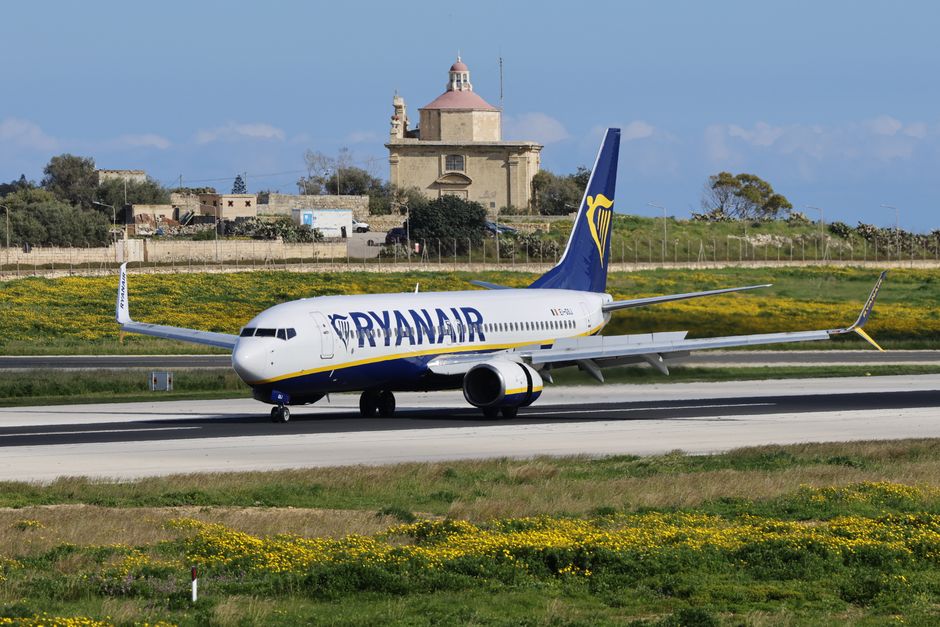
A passenger was partially sucked through a broken cabin window on a Ryanair Boeing 737 shortly after take-off from Thessaloniki, Greece, on Friday, forcing the aircraft to make an emergency landing and leaving the Serbian national hospitalised — though not with life-threatening injuries.
The flight was bound for Memmingen airport in Germany when the incident occurred, reportedly over North Macedonian airspace. The aircraft returned to Thessaloniki, where investigators are now examining what caused the window to fail.
What happened on board the Ryanair flight
According to the Serbian consulate, the passenger — a Serbian national — was transferred to the AHEPA University General Hospital in Thessaloniki after the incident. Doctors were working to determine the full extent of his injuries, with the consulate confirming no life-threatening harm had been sustained.
A passenger on board was quoted in Serbian media as telling a Thessaloniki radio station that the man's head and shoulders had gone through the opening before fellow travellers managed to pull him back inside the cabin. Unverified videos circulating on social media appeared to show the broken window and oxygen masks hanging from the ceiling of the aircraft.
Ryanair confirmed in a statement that "a passenger window dislodged in-flight" and that the plane returned to Thessaloniki as a result. The airline added that "the aircraft landed normally and passengers returned to the terminal." The cause of the window failure was not addressed in Ryanair's statement, and the airline did not immediately respond to further questions about the incident.
Greek local media reported that a piece of the engine broke away early in the flight, struck the fuselage and smashed the window, causing the cabin to depressurise. Two airport sources with direct knowledge of the incident confirmed those details. Uncontrolled decompression of this kind — where cabin pressure drops suddenly after a structural breach — poses a serious risk to passengers and crew at altitude.
Social media footage also appeared to show evidence of an uncontained engine failure on the aircraft, with fan blades visibly missing. Such a failure occurs when internal engine components shatter and break through the engine casing, sending high-speed debris outward.
The aircraft and its recent history
The US Federal Aviation Administration confirmed the plane involved was a Boeing 737 NG — the Next Generation variant that predates the current 737 MAX series. Ryanair operates CFM56 engines, manufactured by CFM International — a joint venture between General Electric and France's Safran — across its entire 737 NG fleet. CFM International did not respond to requests for comment.
Flight tracking data revealed a troubling detail: the same aircraft had already diverted back to Thessaloniki the evening before, on a separate service to Sarajevo, also shortly after take-off. The reason for that earlier diversion remains unclear.
Boeing said it is assisting the investigation, which is being led by North Macedonia given the incident occurred in its airspace. "We remain in contact with and continue to support our customer, Ryanair," the company said. The FAA also confirmed it was ready to assist the investigation.
Echoes of a deadly 2018 incident
The Thessaloniki incident drew immediate comparisons to a 2018 accident involving another Boeing 737 NG, operated by Southwest Airlines, in which a fan blade snapped inside an engine, sending debris that shattered a cabin window. A 43-year-old passenger was partially pulled through that window and died from injuries sustained — becoming the first fatality in a US commercial airline accident in nine years.
Tammie Jo Shults, the pilot who was widely praised for her composure in landing the Southwest flight safely, said on Friday she was struck by the similarities between the two events. "They have an engine that goes out. There is external damage. It's not just an engine that has quit working and so there's more drag with that," she said.
Following the 2018 disaster, the US National Transportation Safety Board called on Boeing to redesign the fan cowl structure on its 737 NG aircraft. The FAA issued a formal directive in 2023 requiring that redesign to be completed by July 2028.
Investigation under way
The aircraft remained on the ground at Thessaloniki airport as investigators examined the plane. Greek airport sources confirmed authorities were actively looking into the sequence of events that led to the engine failure and subsequent window breach.
With the same plane having turned back twice in the space of 24 hours, and with scrutiny of the 737 NG platform already heightened following the 2018 Southwest tragedy and ongoing questions about Boeing's manufacturing standards, the Thessaloniki incident is likely to intensify calls for closer oversight of ageing 737 NG aircraft still in active service across European and global fleets.