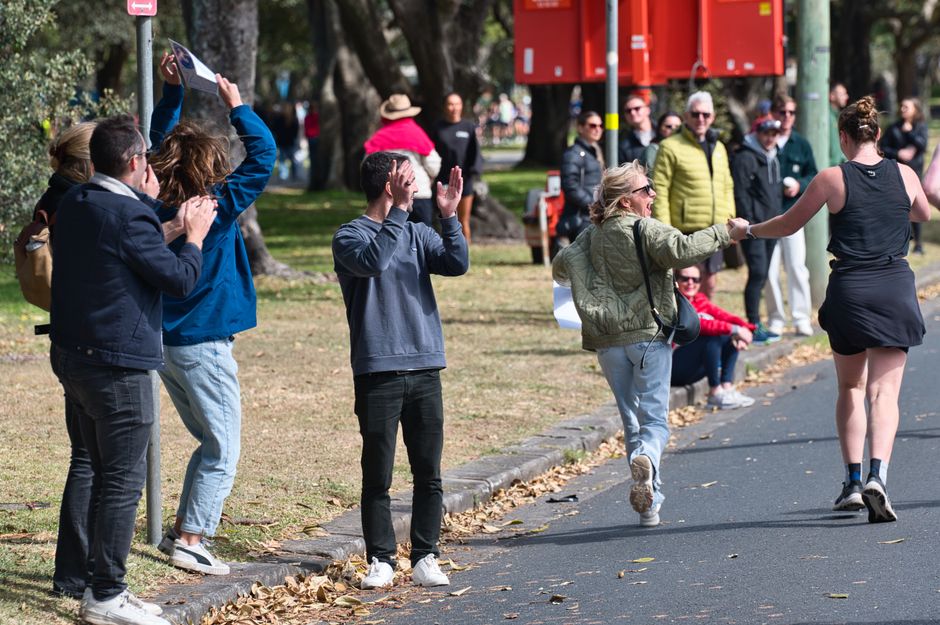
More than 40,000 runners took to the streets for the Sydney Marathon on Sunday, transforming one of Australia's largest cities into a rare moment of communal warmth — until hateful signs targeting Israelis cut through the spirit of the event and sparked immediate controversy.
An eyewitness who ran in the race described seeing accusatory, hate-directed messages aimed at Israelis among the crowds lining the course. While the precise intended targets of the signs could not be determined with certainty, the witness said it was difficult, given the current social climate, to interpret them as anything other than messages directed at Israeli participants or those perceived to be affiliated with Israel.
A Jarring Intrusion Into a Celebration of Shared Humanity
The marathon, which draws tens of thousands of participants from across Sydney's famously diverse population, is widely regarded as one of those rare occasions where background, birthplace, language and religion become irrelevant. Runners share the same course, drink from the same cups and are cheered on by the same strangers. It is, by its nature, an event defined by solidarity rather than division.
That context made the appearance of hate-laden signs all the more jarring. The witness noted that what was most troubling was not the political content of the signs in isolation, but the spirit in which they were deployed — inserted into an event whose entire character was the antithesis of conflict.
"Does telling a stranger they are hated move anyone closer to a solution?" the witness wrote, questioning whether importing the language of collective guilt into a community sporting event generates empathy for Palestinians, or simply leaves people feeling frightened, humiliated or despised.
Questions Over the Purpose of Protest Without Persuasion
The incident has reignited debate about where the line falls between legitimate political protest and targeted hostility. It is broadly accepted that criticism of the Israeli government or its military is not inherently antisemitic. However, observers have long noted there is no impermeable wall separating anti-Zionism from antisemitism, and that in certain circumstances the distance between the two can become vanishingly small.
A useful test, the witness suggested, is whether the same standard would be applied universally — to Russians held responsible for the Kremlin, to Chinese Australians held accountable for Beijing, or to any other group of ordinary people publicly confronted with the actions of governments or nations with which they are associated.
Among those taking part in the Sydney Marathon were Israeli runners understood to be raising money for Shalva, a disability non-government organisation that serves Jewish, Muslim, Christian and Druze Israelis alike. Many Israeli runners are likely to be former military personnel given Israel's national conscription policy — a fact that, the witness argued, underscores the futility of protest that appears uninterested in nuance or persuasion.
"If the person passing you is not someone whose mind you hope to change, and not someone with power to implement the change you seek," the witness wrote, "then what precisely is the purpose of confronting them?"
Collective Guilt and the Risk of Closed Political Movements
The episode has prompted broader reflection on how political movements can become so enclosed within their own language and moral certainty that they lose sight of how they appear to those outside their circles. Slogans harden into articles of faith. Ideas recirculate among the already-converted until the act of expression becomes confused with actual achievement.
Australia's social fabric, the witness observed, functions — imperfectly but remarkably — because people carrying vastly different histories, religions, languages and loyalties can share the same spaces without being reduced to proxies for distant governments or conflicts. The Sydney Marathon, at its best, embodies precisely that principle.
When signs of collective hatred appear at such events, they do not merely make a political statement. They make some Australians feel they do not belong — and that, whatever the stated cause, is a outcome worth naming plainly.