Grave fears are held for 34 Australians among the hundreds of people unaccounted for after catastrophic flash floods tore through the mountainous Nepal-Tibet border region on Wednesday, with the death toll climbing to at least 160 as search and rescue teams work across both sides of the frontier.
Nepali police report at least 157 bodies have been recovered on the Nepalese side of the border alone, while Chinese state broadcaster CCTV confirms at least three deaths and 265 people missing in Tibet's Gyirong County. The toll is widely expected to rise as recovery operations continue in remote and heavily damaged terrain.
Who Is Missing — and Where
According to tourism board spokesperson Sunil Sharma, 403 people in total have been reported missing, including 341 foreign nationals. The breakdown of missing foreign citizens includes:
- 133 Indian nationals who were on a pilgrimage to Mount Kailash in Tibet, a sacred Hindu site
- 47 Americans
- 34 Australians
- 33 British nationals
- 24 Canadians
- Eight South Korean citizens who were working on a hydropower plant in the region
At least 62 missing Nepali citizens are believed to have been trekking in the Gosaikunda Lake area of the Rasuwa district, coinciding with the local festival of Janai Purnima. A Nepali police spokesperson confirmed at least 28 police officials are also among those unaccounted for. The Australian Department of Foreign Affairs and Trade had not responded to requests for comment at the time of reporting.
A Wall of Mud, Rock and Water
The disaster unfolded with terrifying speed along the Nepal-Tibet border on Wednesday morning. Security footage from the Chinese side of the Rasuwagadhi border crossing — known as Gyirong Port — captured the moment a torrent of rock, mud and water overwhelmed buildings and vehicles, leaving survivors with seconds to react.
Twelve tourists who had just crossed through Gyirong Port described looking over their shoulders to see a mud-filled wave more than 20 metres high surging towards them down the narrow valley before they fled for their lives. The tour group had been led by Alpine Eco Trek, a local operator running regular 10-day trips from Kathmandu to Tibet's sacred Mount Kailash.
"Both guides went offline at 8.42am," said the tour company's manager. "The whole area was swept away by the flood. Even the Tibet immigration office."
Survivors described harrowing escapes. Bibek Kumal, a 24-year-old labourer working in Bidur, downstream from the hardest-hit Rasuwa district, said he heard a hissing sound before his co-workers screamed at him to run. He had been digging a toilet pit when the water arrived.
"I started running. Then a wall of water came thundering down as if it was an earthquake," Kumal said from his bed at Kathmandu's National Trauma Centre. He survived only because the floodwaters carried him into a mango tree, where he clung until rescued.
Sixty-eight-year-old survivor Keshav Prasad Baral described watching the surge enter his home. "I tried to grab my wife's hand and take her to the terrace. But she was swept away by the mud," he said while being treated at a local hospital. "Four or five hours later, a helicopter came to rescue me. My wife is still somewhere beneath the mud. She's gone."
What Caused the Floods
Initial investigations point to a landslide of ice and rock as the trigger. Nepal's National Disaster Risk Reduction and Management Authority said an analysis of satellite imagery indicated the debris-laden flood originated in the Lhende River, approximately 20 kilometres northeast of the Rasuwagadhi border crossing.
The German Research Centre for Geosciences recorded a 4.4-magnitude earthquake approximately seven minutes before the event shown on border security footage, consistent with early reports from Nepali officials suggesting seismic activity may have caused the lower portion of a glacier to collapse and set off the flood.
The broader Himalayan region has become increasingly vulnerable to events of this kind. Scientists have documented how extreme heat events and accelerating glacial melt driven by human-caused climate change have made flash floods, landslides and other catastrophic weather incidents more frequent across the region.
Search Operations and Government Response
The Nepalese army has confirmed that combined search operations on both sides of the border have so far resulted in the rescue of 88 people. Drone footage from the Tibetan side showed roads obliterated and buildings buried under debris.
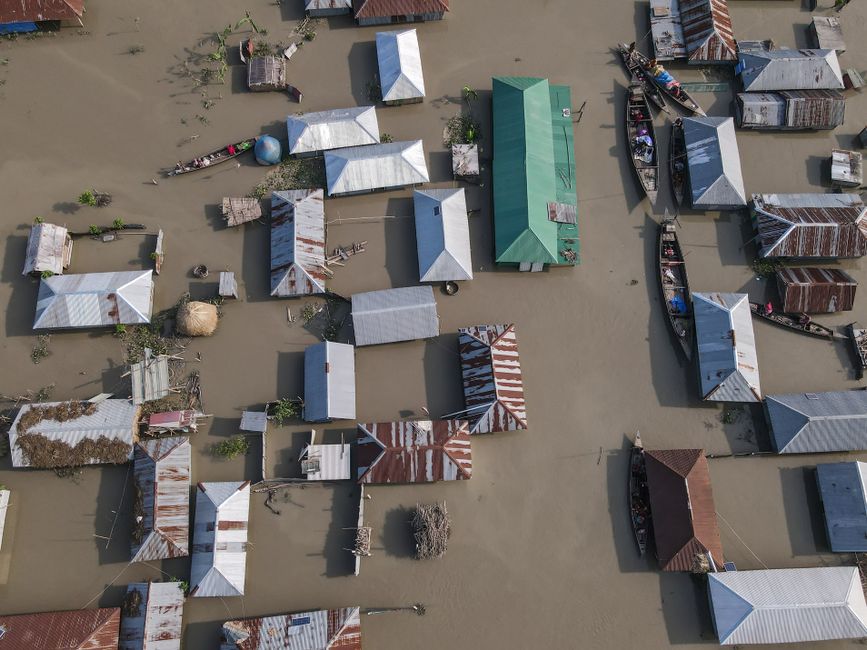
Authorities warned residents across several districts to remain away from the banks of the Bhotekoshi, Trishuli and Narayani rivers. The Bhotekoshi flooded around 9am Wednesday, destroying villages, roads and hydropower infrastructure along its banks.
A Nepali government spokesperson confirmed that both India and China had been formally asked to assist with ongoing rescue efforts. Images emerging from the hard-hit Nuwakot district showed entire lower floors of buildings buried in mud, with debris tangled in tree branches and power lines — a stark illustration of the flood's destructive force.
As recovery operations continue, authorities on both sides of the border are warning the final toll could be significantly higher.