Most of us wouldn’t tolerate a house full of junk we never use. Yet when it comes to our digital lives, Australians are quietly accumulating thousands of files across dozens of devices, cloud accounts, and forgotten hard drives — and paying for the privilege. From duplicate photos clogging up iCloud to old tax returns scattered across three different laptops, digital hoarding has become a silent financial drain that few of us stop to examine.
The average Australian household now manages over 20 connected devices, according to recent industry data. That’s 20 potential dumping grounds for files, downloads, and media that rarely get organised, let alone deleted. When storage fills up, the knee-jerk reaction is predictable: upgrade the cloud plan. What starts as a free 5GB iCloud tier quietly becomes a $4.49 monthly charge, then $14.99, then $54.99 for the 2TB tier. Multiply that across family members and it starts to sting.
The Psychology Behind Keeping Everything
There’s a reason we hoard digitally. Unlike physical clutter, digital files don’t take up visible space. You can’t trip over 40,000 unorganised photos or stub your toe on 300 downloaded PDFs you’ll never read again. The cost of keeping everything feels negligible — until it isn’t.
Psychologists have drawn parallels between physical hoarding disorder and digital accumulation behaviour. The anxiety of deleting something “just in case” is real, even when the likelihood of needing that file again is vanishingly small. It’s the same impulse that keeps people holding onto broken appliances in the garage — except there’s no garage sale equivalent for your Downloads folder.
The Real Cost of Disorganised Files
Beyond storage fees, digital clutter has a productivity cost. A McKinsey report found that knowledge workers spend roughly 20% of their work week searching for information. For freelancers, tradies, and small business owners — the backbone of the Australian economy — that wasted time translates directly into lost income.
Think about the last time you needed a specific document. A receipt for a warranty claim. A contract you downloaded six months ago. A training manual from a supplier’s website. If you’re like most people, you probably spent far longer searching for it than actually reading it. And there’s a fair chance you gave up and just downloaded it again.
This is where the cycle gets expensive. Re-downloading files you already have, paying for cloud storage to house duplicates, subscribing to multiple backup services because you don’t trust any single one. It’s a mess that compounds over time.
A Smarter Approach to Downloading and Organising
The first step isn’t deleting everything. It’s being smarter about how you acquire and store files in the first place. Instead of downloading files one at a time from websites, scattering them across your desktop, and forgetting where they came from, there are tools designed to handle this more intelligently.
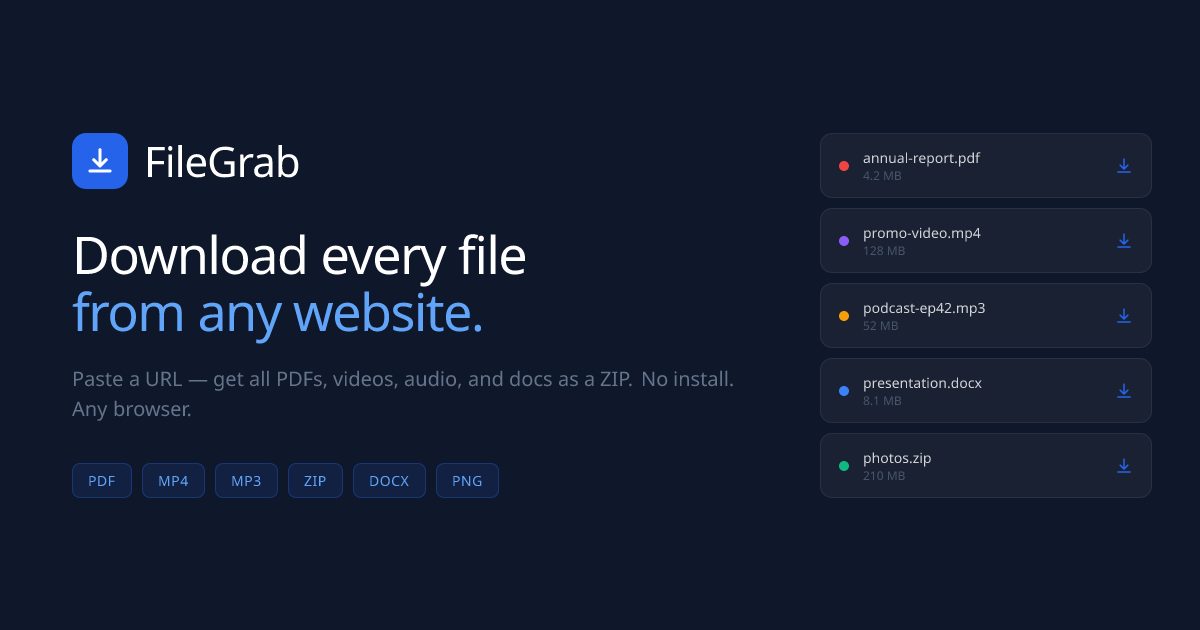
Web-based file extraction tools like FileGrab let you paste a URL and instantly see every downloadable file on that page — PDFs, images, documents, videos, the lot. Instead of right-clicking and saving files individually (and inevitably missing half of them), you can scan an entire page or even a full website, select what you actually need, and download everything as a single organised ZIP file. It’s a surprisingly simple fix for a problem most people don’t realise they have.
For anyone who regularly pulls resources from government sites, supplier portals, or training platforms — which is a lot of Australians working in trades, healthcare, education, and professional services — this kind of approach can save hours every month and keep your file system significantly cleaner.
The Environmental Angle Nobody Talks About
Here’s something that doesn’t get enough airtime: storing data isn’t free for the planet either. Data centres consume enormous amounts of energy, and every duplicate file, every abandoned cloud account, every forgotten backup contributes to that footprint. The International Energy Agency has flagged data centres as one of the fastest-growing sources of electricity demand globally.
Australians tend to care about environmental impact — we’re a nation that recycles, that banned single-use plastic bags, that increasingly drives electric vehicles. But digital waste doesn’t have the same visibility. There’s no bin night for your Google Drive. So it accumulates, silently, year after year.
Practical Steps to Cut the Digital Clutter
Getting on top of your digital files doesn’t require a weekend-long purge. Start with a few targeted habits. Audit your cloud subscriptions quarterly and ask whether you actually need the tier you’re paying for. Consolidate files from multiple devices into a single, well-organised structure rather than syncing duplicates everywhere. Use purpose-built download tools instead of scattering files manually across folders. And critically, delete things you’ll never need again. That 2019 webinar recording isn’t going to age like fine wine.
Digital hoarding might not feel like a real problem because it’s invisible. But when you add up the subscription fees, the lost productivity, the environmental impact, and the quiet stress of never being able to find what you need — it’s a problem worth solving. And like most problems, it starts with awareness.