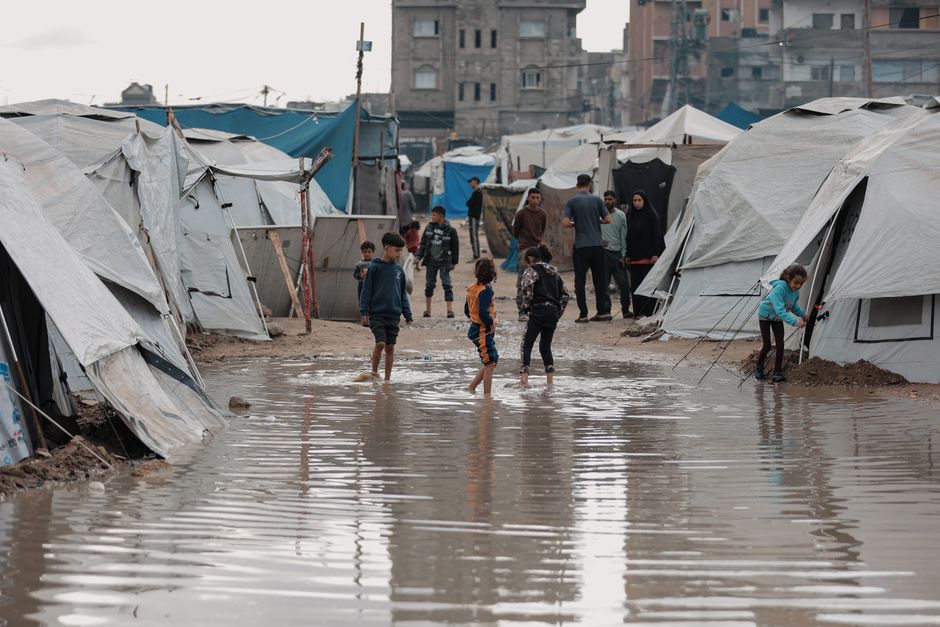
Four people, including three children, have been killed and tens of thousands of makeshift shelters inundated after heavy rains swept through Gaza, compounding what aid organisations are describing as a catastrophic humanitarian emergency for nearly two million displaced Palestinians.
The deaths occurred on Sunday evening when a sand embankment in Deir al-Balah collapsed onto tents housing displaced families following intense rainfall, according to the Palestinian Ministry of Health. The flooding has been worsened by El Niño weather patterns, which are intensifying seasonal rains across the region.
Children Left Fighting Floods with Mugs and Buckets
Humanitarian organisation Plan International warned on Wednesday that waterborne diseases now pose a serious threat to families who have already lost food supplies, including flour, rice and bread, to the floodwaters.
Plan International's Global Humanitarian Director, Dr Unni Krishnan, painted a devastating picture of conditions on the ground.
"We are hearing heartbreaking stories of children trying to fight the floods with nothing but mugs and buckets," he said. "Having already endured displacement multiple times due to a brutal war and the trauma of homelessness, children in Gaza are now facing catastrophic floods. There is only so much a child can endure."
Dr Krishnan warned that the onset of winter is placing thousands of children in life-threatening conditions, adding yet another layer of suffering to an already desperate situation. The United Nations estimates that nearly two million Palestinians are currently displaced within the territory.
International Pressure Mounts Over Israel's Response
US President Donald Trump's Board of Peace, a body that has generally avoided strong criticism of the Israeli government, issued a statement on Monday calling on Israel to authorise the entry of essential materials, including temporary shelter, water and sanitation infrastructure, drainage equipment and sewage removal supplies.
"The urgent entry and distribution of essential shelter, sanitation, drainage, and other winterisation supplies is critical to protecting civilian lives," the board said.
Philippe Lazzarini, the former head of the UN Relief and Works Agency for Palestine Refugees, described the board's statement as an "understatement." While acknowledging what he called a "rare recognition" that Israel was not doing enough, Lazzarini accused the board of failing to use its leverage to address what he described as the "disgraceful dystopian misery" of Palestinians in Gaza.
Israel's prime minister's office responded on Tuesday, saying the country would "continue to support winter preparedness in Gaza" and pointing to humanitarian supplies it said had already entered the enclave. The statement argued that Hamas would exploit any dual-use materials entering Gaza to reinforce its military capabilities, framing the issue as a shared challenge between Israel and the Board of Peace.
For more background on the complex political landscape shaping conditions in Gaza, see our coverage of Hamas dissolving Gaza's governing body amid an ongoing weapons dispute.
Ceasefire in Name Only as Civilian Toll Rises
Since a nominal ceasefire came into effect in October 2025, more than 1,400 people have been killed in Gaza by near-daily Israeli strikes, according to the United Nations. No hospitals in the territory are reported to be fully functioning.
British Foreign Secretary Ed Miliband, who has led a multinational push to impose sanctions on Israeli settlements in the occupied West Bank, added his voice to international concern over the flooding.
"The humanitarian situation in Gaza is getting worse. Heavy rain. Flooded tents. The reality on the ground is heartbreaking," Miliband said. "The UK government will not stand by. We will not rest until we bring an end to the intolerable suffering."
With winter deepening and aid access remaining severely restricted, humanitarian groups are warning that conditions for Gaza's displaced population are likely to deteriorate further in the weeks ahead unless immediate action is taken to deliver emergency shelter and sanitation support.