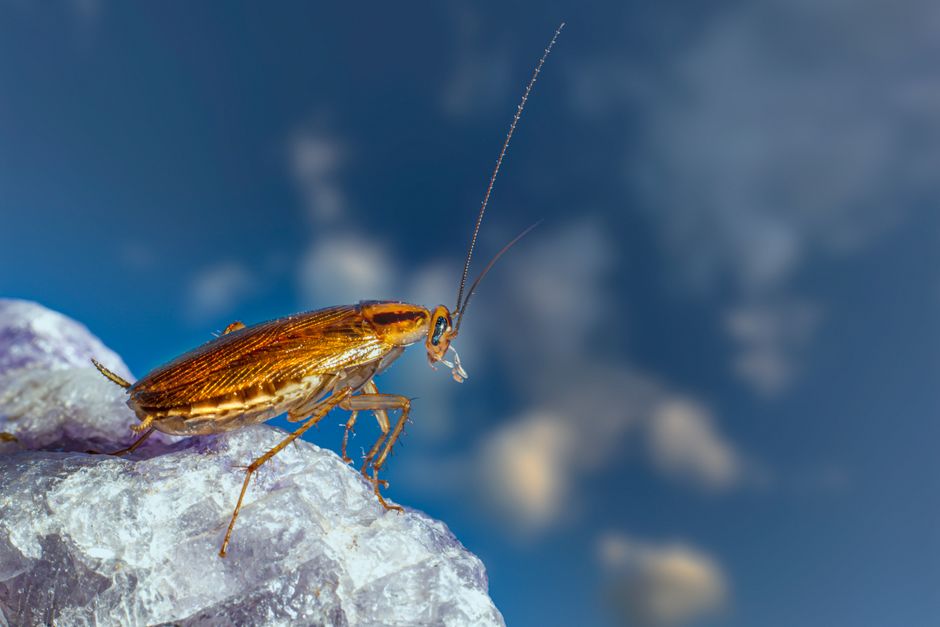
Australian researchers have engineered remote-controlled cockroaches capable of firing medicine-loaded syringes into disaster victims, in a breakthrough that could one day transform how emergency responders reach people trapped in collapsed buildings or remote caves.
The so-called "paraborg" — a blend of paramedic and cyborg — is built from the giant burrowing cockroach, the world's heaviest cockroach species and a native of north Queensland. Fitted with a harpoon-style backpack capable of deploying a needle on command, the insects are being developed as a first-response tool for scenarios where human rescuers and conventional robots simply cannot go.
How the cyborg cockroaches work
The insects are converted into remote-controlled devices through the careful insertion of electrodes into their antennae. Because antennae naturally detect obstacles, stimulating the left antenna causes the cockroach to veer right, and vice versa. A second set of electrodes fitted to the cerci — sensory appendages at the rear of the insect — allows operators to accelerate or halt the creature using a joystick.
Biorobotics specialist Dr T. Thang Vo-Doan from the University of Queensland, who leads the research, acknowledged the unconventional working environment. "It's not for everyone," he said. "But we have a very good relationship with them in the lab."
Vo-Doan argues the cockroach's natural capabilities make it vastly superior to current small robotics for navigating disaster zones. "The insect can climb and run, even carry heavy loads in different orientations in a complex environment," he said. "You already have everything from nature. It simplifies our system a lot in terms of design and engineering."
Critically, while small robots are hamstrung by short battery lives, cockroaches can operate for days sustained by nothing more than gum leaves and apple slices.
The syringe-firing system put to the test
The latest study, published in the journal Advanced Science, focused specifically on the medical delivery aspect of search and rescue. Researchers tested whether a paraborg could navigate to a target and successfully administer an injection — simulating a scenario such as treating a sepsis patient buried under rubble.
The results were promising. Across proof-of-concept trials, the needle-firing system achieved a 72 per cent overall success rate. When a cockroach closed to within 15 centimetres of its target, that hit rate climbed to 95 per cent.
PhD candidate and lead author Hai Nhan Le acknowledged the optics of the approach may unsettle some people. "A lot of people might not like the sight of a giant cockroach scurrying towards them," he said. "But if you're trapped in rubble or stuck in a cave and need help, it could make a real difference between life and death."
A fully autonomous paramedic swarm — the long-term vision
The ultimate ambition is to deploy a "fully autonomous paramedic team composed of terrestrial cyborg insects" capable of independently locating victims, relaying information back to rescuers, and delivering medication — all without human guidance at each step.
The concept is already gaining traction internationally. Ten cyborg Madagascan hissing cockroaches equipped with infrared cameras and sensors were deployed alongside Singapore's Operation Lionheart rescue team, demonstrating that insect-based rescue technology is moving from the laboratory into operational field trials.
While fully robotic, insect-inspired rescue machines remain a future goal, Vo-Doan believes the hybrid approach — living insects augmented with technology — offers a viable bridge. Robots, he notes, are not yet small, agile or energy-efficient enough to operate effectively in the chaotic environments created by earthquakes or building collapses.
On the question of animal welfare, the team reports that cockroaches are anaesthetised before electrodes are inserted, and all electronic systems are removed after experiments. There is no requirement for ethical approval for insect research, and the researchers say their cyborg recruits appear to live as long and as healthily as non-modified cockroaches.