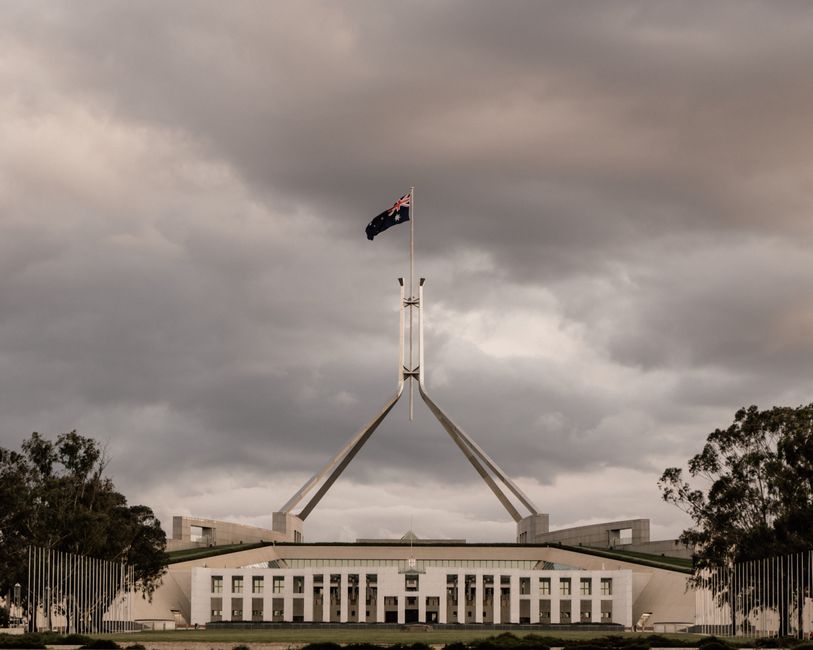
Former Treasury secretary and prime minister's department chief Martin Parkinson has delivered a pointed rebuke to politicians across the spectrum, arguing that migrants are not responsible for Australia's housing crisis and that arbitrary cuts to immigration numbers will do little to restore public trust in the nation's migration program.
Parkinson, who authored a key federal government migration review and now serves as chancellor of Macquarie University, made the argument in a speech at Macquarie University in Sydney, laying blame squarely with politicians who have failed to be honest with voters about planning failures and productivity-damaging policies.
Housing crisis has deeper roots than migration
While acknowledging that the surge in net overseas migration following the pandemic, which reached a record 550,000 in late 2023, had some impact on the property market, Parkinson argued it was not the fundamental cause of the housing crunch.
"The crisis has deep roots in a decade or more of too little building, restrictive planning, rising construction costs and a shortage of tradespeople," he said in his prepared remarks. "Australia's inability to address self-imposed supply constraints is the root cause of the build-up in excess demand."
The record migration peak coincided with the largest jump in property prices in 30 years and a sharp rise in rents, a combination that has fuelled public frustration. But Parkinson insists the blame lies with governments that failed to plan for infrastructure and services, not with the migrants themselves. Those concerns about supply-side obstacles worsening Australia's housing crisis continue to be felt across the community.
Party plans are 'slogans', not solutions
With Labor, the Coalition and One Nation all competing to offer lower net overseas migration as a political solution, Parkinson warned that none of the three major proposals contain enough detail to be credible. Net overseas migration currently adds around 300,000 people to Australia's population each year.
"A target that cannot answer those questions is nothing more than a slogan," he said, calling out the lack of specifics around which visa categories would be cut, which jobs or regions would be affected, and how housing and services would actually improve as a result.
He was equally critical of the financial opacity surrounding each plan. "We do not really know what any of these proposals would cost. Not one of the three has published enough detail to tell us. These decisions have wide and deep economic and budget impacts, yet we are being asked to make them in the dark," he said.
Parliamentary Budget Office modelling provides the closest available approximation of costs. That modelling indicates that One Nation's proposal for three years of negative migration would add an extra $275 billion to national debt. The Coalition has stated its plan to reduce migration to 100,000 for two years would be budget neutral, but has not released the underlying costings. Meanwhile, Labor's move to drive net migration down to 225,000 was followed by a retreat on its backpacker visa policy.
A system that has lost its purpose
Parkinson argued that Australia's migration program has drifted far from its original design, becoming primarily a system of temporary labour supply driven by international education, while long-term planning for infrastructure and services has fallen behind.
"It is not that migration has failed. It is that we have lost sight of what migration was for. And once you lose sight of the purpose, you lose the ability to plan for it, to explain it, and in the end, to defend it," he said.
He warned against repeating past mistakes by simply reversing course without a clear framework. "We are now repeating the original error. We are setting numbers without a purpose, from the other direction. If we cut by decree, we will lose the benefits and we will not have fixed the system."
Parkinson, who served in senior roles under both Coalition and Labor governments, added his voice to calls for a national migration summit that would bring together government, business, unions, settlement organisations and economists to build a long-term, evidence-based vision for Australia's migration program and restore community confidence.