Australia's most expensive homes are losing value at more than twice the rate of entry-level properties, with new data showing upper-quartile prices in Sydney and Melbourne down more than 10 per cent from their peaks — and property analysts warning the high end of the market is a reliable early signal of where the broader sector is heading.
Figures from property analytics firm Cotality reveal that while homes in the lower quartile have declined by between 3.9 and 5.4 per cent from their highs, those in the top 25 per cent of the market have shed more than 10 per cent in both cities. The divergence is stark, and according to Cotality's executive research director Tim Lawless, it follows a well-established historical pattern.
"The top end of the housing market historically moves first in a property cycle," Lawless said, noting that while the broader market peaked in March, upper-quartile prices had already turned as early as October and November the previous year.
A $7 million loss and a widening discount gap
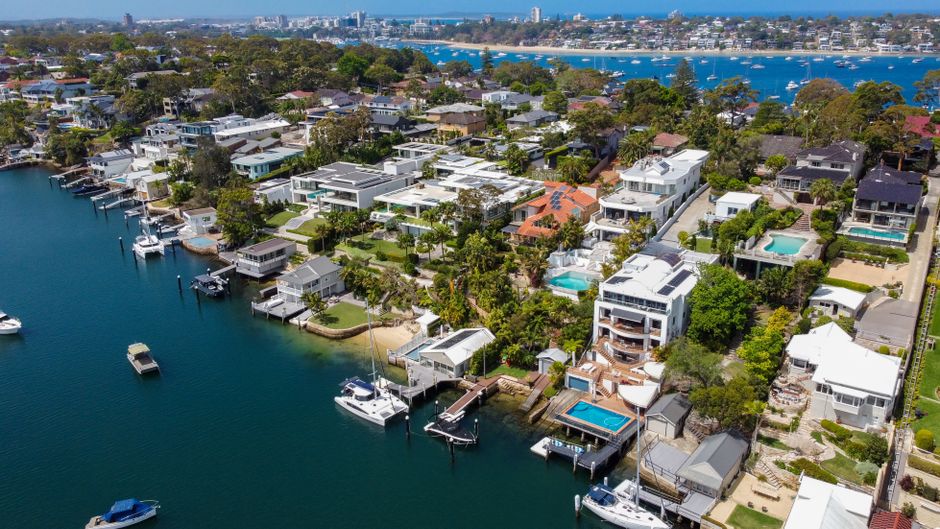
The numbers are not abstract. In Sydney's harbourside suburb of Balmain East, a mansion that changed hands for close to $20 million in 2022 was resold this month for $12.8 million — a loss of roughly $7 million in just a few years. It is an extreme example, but it reflects a broader trend playing out across premium postcodes in both cities.
Vendor discounting has been widening and properties are sitting on the market for longer, signs that the demand once supporting sky-high prices at the luxury end has quietly evaporated. Wealthy buyers, it appears, are in no rush to step back in.
The director and chief auctioneer at New South Wales independent firm AuctionWorks, Davidson, said the sharpest round of price adjustments had likely passed, but the market had not yet found its floor.
"The top end of the market has been the most affected, with significant price adjustments occurring in recent months," Davidson said. "However, it appears that whilst we may not yet have seen the bottom of the market, the price reductions have certainly slowed."
He added that some buyers were beginning to recognise value, but urgency remained absent from high-end auctions. "Buyers are starting to see some value, however, there is no urgency to jump in just yet. This will change in the months ahead when price reductions slow even further."
How rising borrowing costs are reshaping who buys what
Underlying the luxury slump is a brutal affordability squeeze driven by the Reserve Bank's sustained rate-hiking cycle. With effective borrowing rates now hovering around 9.5 per cent, purchasing power has been severely curtailed across the market. A household earning a median income is now spending more than 50 per cent of its pre-tax income servicing a median-priced mortgage — a threshold widely considered unsustainable.
The practical consequence, according to Lawless, is a cascading shift in buyer behaviour. Those who might previously have stretched into the mid-to-upper price bracket are being pushed firmly toward cheaper stock, concentrating demand — and competition — at the lower end.
"Mainstream demand is getting deflected towards lower price points where buyers can actually demonstrate an ability to service the loan," he said.
That means first home buyers, investors and price-sensitive mid-tier purchasers are all competing for a limited pool of affordable listings. The result is a two-speed market: relative resilience at the entry level, and a demand vacuum at the top that has left luxury vendors exposed to mounting discounts and extended selling timelines. This dynamic is directly tied to the broader pressures household debt and house prices are placing on Australians, with financial stress reshaping not just property decisions but wider social and political attitudes.
Political fault lines open over the correction
The property downturn has ignited a sharp political debate about causes and responsibility. Opposition leader Angus Taylor and senior Coalition figures have pointed to the federal government's recent adjustments to negative gearing settings, arguing that market confidence has been "smashed" by policy uncertainty.
Opposition treasury spokesperson Tim Wilson said the housing correction "doesn't help" anyone — arguing that first home buyers are forced to spend more at the same time as existing homeowners watch their wealth erode.
Labor leaders, including Treasurer Jim Chalmers, have firmly rejected that framing, though the political contest over housing affordability and property values shows no sign of cooling.
What comes next for homeowners watching from the sidelines
The consistent historical lesson from premium market downturns is that the correction rarely stays contained at the top. When wealthy buyers retrench and high-end listings accumulate, sentiment shifts, credit conditions tighten further, and the repricing pressure eventually filters through to more modest price brackets.
For now, Lawless and others are watching two key indicators: whether the pace of rate-driven credit tightening eases, and whether high-end buyers — who remain cautious but are beginning to detect value — start returning to auctions with greater conviction. Until both conditions shift, Australia's most expensive suburbs look set to remain a leading indicator worth watching closely, regardless of what price bracket you call home.
Upper-quartile declines in Sydney and Melbourne of more than 10 per cent represent a significant repricing of aspirational wealth — and while the sharpest falls may be behind us, the full consequences for the broader Australian property market are still unfolding.