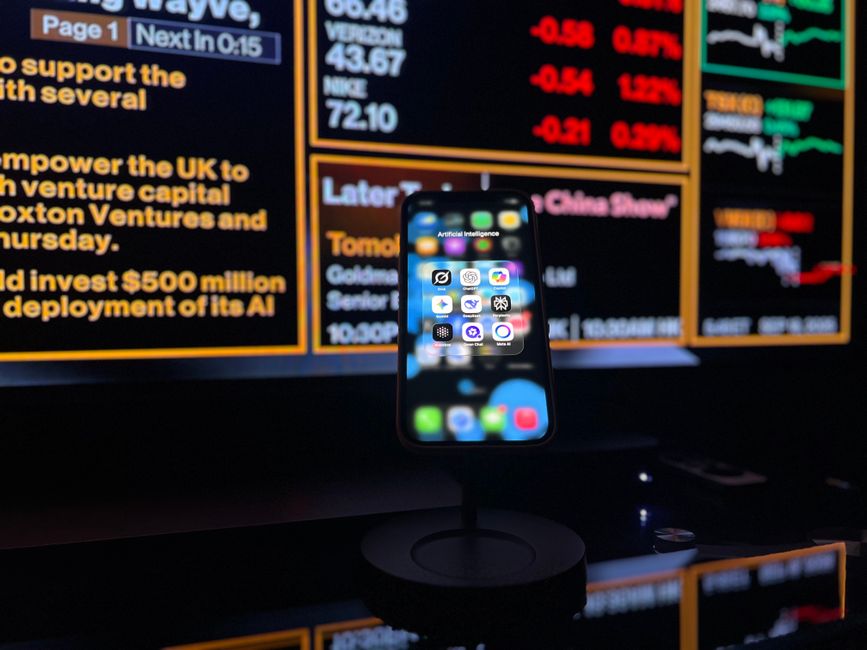
Anthropic has made history as the world's first publicly traded frontier artificial intelligence company, reaching a peak market value of $US2.1 trillion (approximately $3.1 trillion Australian) on its Nasdaq debut. But the landmark listing failed to fully reignite investor confidence in the AI sector, with shares retreating from their opening surge amid a broader technology sell-off.
The stock opened at $US111.50, around 34 per cent above its IPO price of $US83, before paring gains to trade near $US99. The company had priced its initial public offering above its marketed range of $US70 to $US78, selling 980 million shares at $US83 each. If underwriters fully exercise their option to purchase additional shares, IPO proceeds could reach as much as $US93.5 billion ($139 billion Australian).
A turbulent week for AI marks the backdrop to Anthropic's debut
The listing capped a volatile week for the artificial intelligence industry, overshadowed by a scandal-tinged departure of Nvidia chief executive Jensen Huang. That episode had already softened some of the market's enthusiasm heading into Anthropic's first day of trading.
Jake Behan, head of capital markets at Direxion, framed the week in stark terms ahead of the debut. "I've looked at this whole week as a referendum on AI," he said. "Nvidia gave us a read on the build-out, and Anthropic is about to give us a read on investor appetite for the next generation of AI companies."
The debut places Anthropic in elite company. With its opening-day valuation, the company joins the trillion-dollar club alongside Microsoft, Apple and Nvidia, a milestone that would have seemed extraordinary for a company that had not yet traded on a public exchange.
Investor scepticism grows over AI's enormous costs
Despite the headline-grabbing numbers, the listing has done little to dispel growing unease about trillion-dollar valuations across the technology sector. Investors who once embraced the AI boom have grown increasingly cautious in recent weeks, concerned that the enormous capital expenditure required to build out the sector may not ultimately be justified by returns.
Debate has intensified across global markets over whether the AI boom is drifting into bubble territory, with economists, chief executives and political leaders divided on its long-term sustainability. Much of the scrutiny has centred on circular financing arrangements connecting AI companies and their major backers.
Anthropic itself has signalled it may turn to debt markets for future funding. Chief executive Dario Amodei said the company hopes to eventually achieve investment-grade status and use debt as a financing instrument. "At some point in the future we're hoping to be investment grade, and debt is an instrument that we have available to us, and we'd like to use at some point in the future," Amodei told a television interviewer.
Thousands of millionaires created as OpenAI eyes next listing
The IPO is expected to generate a wave of new wealth across the AI sector, creating thousands of paper millionaires and a handful of billionaires. Based on the IPO price, Amodei and his six co-founders, who together hold around 10 per cent of the company, had combined stakes valued at nearly $US150 billion ($223 billion Australian). The windfall is set to reward a broad range of employees, from early researchers and engineers through to administrative staff.
As the sector's first publicly traded frontier AI company, Anthropic is now positioned to serve as a benchmark for the industry. Attention is already shifting toward rival OpenAI, which is reportedly considering a public listing as early as 2027, as Wall Street looks for the next major AI float to test investor appetite.
AI technology has had sweeping effects beyond financial markets, boosting economic growth in some sectors while sparking concerns about data centre expansion that are said to have played into a Democratic wave in recent US mid-term elections.